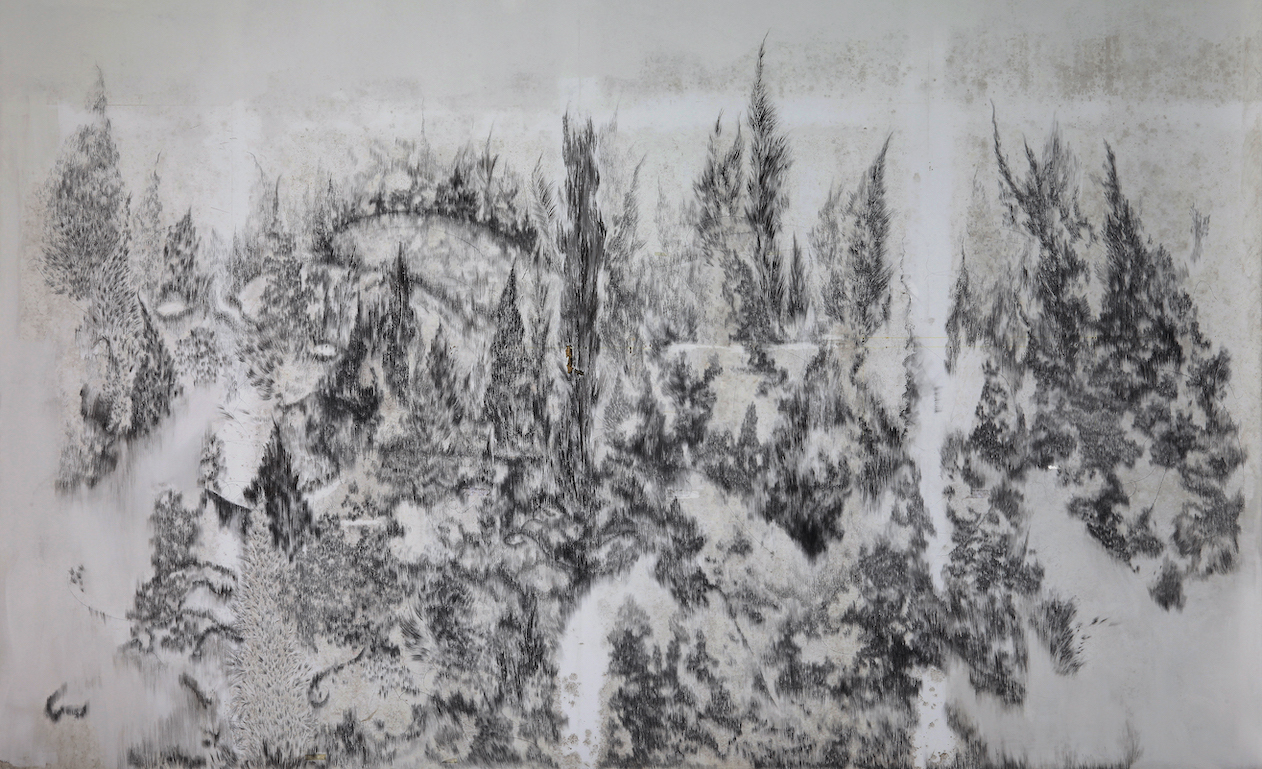
Wall drawing is to express the memory and imagination driven from the already existing traces of the wall. The drawing would not be drawn if it was not the place. The construction process of the wall makes physical trace of screw spike and pit etc. Along with the traces, the long remaining paint wear off of the wall are starting points for imagination. Similar to the saying 'Imagination belies ordinary life', ordinary life is the starting point for imagination. It is also the moment of consoling the vague memories through fantasies.
The process of the action is not necessarily trying to see the meaning of the original. It might be the mixed imagination of the original meaning and the physical traces or it might be the discovery of original meaning. From Agnès Varda's film 《Mur Murs(1981)》, we can observe that from construction site screening to ordinary life wall paintings of a village, they function as recorded memories of the things that occurred in the neighborhood and also serve to remind you about an incident that remains unsolved. Also Murals are drawn to be empathized with the writer and the neighborhood. That moment is when the quietly remaining wall starts to sing a song. But after the end of a construction, murals disappear again by the physical changes-such as winds and rain-gradually. The direct and active physical changes make indirect marks and images on the wall.
2012. 한진 Han Jin.
벽화는 벽에 남겨진 흔적을 따라 기억과 상상을 통해 표현한다. 즉 그 자리가 아니었으면 그려지지 않을 이미지가 된다. 공간 자체에 남겨진, 예를 들면 공사 도중 남겨진 못 자국과 구멍, 오래 시간의 흐름으로 벗겨진 페인트의 부분과 곰팡이 흔적 등 물리적 변화로 인해 다시 복구되어야 할 곳이 오히려 상상할 수 있는 시작점이 된다. 이는 캔버스 안에서 부분적으로는 논리적으로 설명할 수 없는, 그리는 행위로 인한 물감의 패임과 긁힘 그리고 다시 그려지는 부분 부분이 작업을 이어나갈 수 있는 지점이 되어주는 것과 비슷하다. '환상은 일상을 전제하고 있다.'라는 말처럼 일사에서 환상으로의 변화가 시작되는 지점이기도 하다. 환상을 통해 희미한 기억들을 위로하는 순간이기도 하다.
원래의 기능을 상실한 채 버려진 사물들, 특정 공간의 기능을 상실한 채 복구되기를 기다리는 벽. 이것으로 인한 작업의 과정은 반드시 원래의 의미를 관찰시키려 함은 아니다. 원래의 의미와 물리적 흔적 두 지점에서 마주쳐서 생겨나는 환상일 수도, 환상이 다시 원래의 의미를 상기시키기도 하며 잊게도 한다. 아녜스 바르다의 영화 《벽, 벽들 Mur Murs/Mural Murals(1981)》를 보면 공사장 가림막부터 일상을 지배하는 동네 벽의 그림들은 그곳에서 발생한 일들에 관한 추억을 되새기거나 해결되지 않는 사건에 대한 경각심을 일깨워 주는 역할을 한다. 또한 작가와 주변인들이 감정을 이입할 분신으로서 벽화가 그려진다. 조용하던 벽이 노래하는 순간이다. 하지만 공사가 끝나면 가림막은 철거되고 바람과 비, 페인트의 낡음 등 물리적인 변화로 인해 벽화들은 다시 사라진다. 벽에 새기듯 직접적이고 적극적인 행위가 간접적인 이미지로 남는다. 이는 물감의 패임과 긁힘 등 적극적인 그리는 행위를 통한 이미지가 하나의 온전한 형상이 아닌 분절된 이미지로 남는 것과 비슷하다.
2012. 한진 Han Jin.


